
Matters of Creation
2025: Expose yourself, look back and be slow.

«Expose yourself instead of hiding» that’s what my friend, painter Micha Wille, told me some weeks ago when I wasn’t sure whether to do a post in Instagram on a recent project we accomplished. So I am taking her word for good and starting the new year with exposing myself — in the form of a newsletter. This newsletter is news in more than one sense: it is my first newsletter ever. And: It is the first time I am writing under the name of “Matters of Creation” – my NEW studio name.
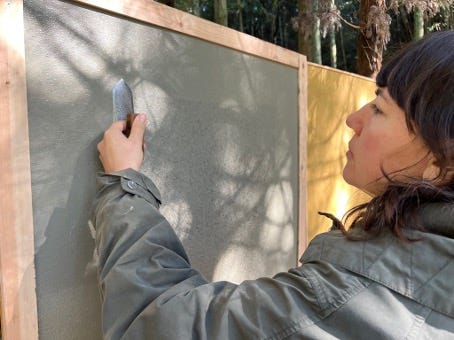
Me, trying to smoothen grey clay with an over 100 year old trowel given to me by the master Yamamotosan.
After years and years of running my work under the name of “Studio Nina Reisinger” I finally feel like detaching my practice from that old given name and turn it into something that not only embraces more possibilities and people involved, but also refers to the act of creation as something delicate yet universal: the word “matter” can be read in the sense of “affairs”, but at the same time it is the word for “substance” — materia — the particle that every THING is made of. Some more etymology: Mater is latin for form but at the same time it means mother. I understand it as the origin of all life: the urmater, mother earth if you want. So “Matters of Creation” pays tribute to our bonds with nature, earth, the universe and creation being this delicate process connected to all of this.
Speaking of Earth: I also discovered a “new” material within the last two years, and I have a feeling that this discovery might have a longterm impact on me and my practice: I discovered earth. Earth as material. So: Life brought me to Japan recently, where I was introduced to the high art of earthbuilding and clay plastering. To plaster walls with earth and to create refined plaster surfaces that had been traditional in japanese architecture for centuries, was something I did not know of until then. It was such a sensual experience to apply and stroke the cool, humid earth with perfectly crafted tools by japanese blacksmiths.
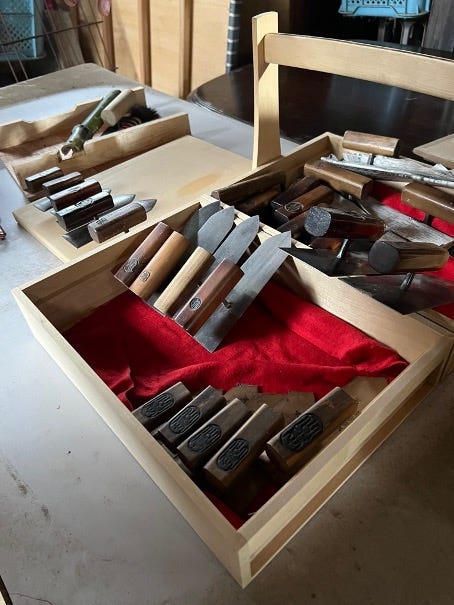
The trowels by japanese clayplaster master Yamamotosan are stored in a self made wooden box with wooden inlays and a lot of detail. The appreciation of detail had been particularly striking to me in japanese culture.
It felt meditative and truly satisfying to accomplish a smooth clay surface. To move my hand along to a thousands-year-old choreography and connect to the material as well as history and ancestors in this way — it was a beautiful experience.
As a Designer wo is usually mostly working with digital tools, and as a professor for Design + Media, I have been very much exposed to the discussion on AI recently. AI is becoming more and more powerful and a topic we all deal with these days. Being in Japan, I found myself being preoccupied with binding my own brush, learning how to hold a trowel right, or cooking up nori seaweed as ingredient for traditional Kyoto Plaster — this felt like the perfect antidote to that ongoing loss of haptic experiences that goes along with digitalization.
The fast pace of technological progress is turning into a machine that is running us rather than the other way around. We try to keep track, look for the new, the next, the easy – and there are millions of apps promising us help with that. But what if we forgot to take a look back because we only look forward? Wouldn’t we lose the connections to our archives, our history? How can we make profound, sustainable, sensible decisions if we are breathless all the time? Im Japan, I allowed myself to be slow, take my time. I can truly recommend this.
Japanese clay plastering let me appreciate slowness more. It gave me an idea of the touch of raw material, the sensual sensation of mixing sand, earth and water, the physical movement and fitness as a requirement to accomplish a task, the smell and the touch of coal, straw, clay and nori.
So my, our should I say our new studio name “Matters of Creation” stands for more possibilities, more people, more techniques, new approaches and refers to the opening of new fields and materials within our design practice in the future. Let’s see where this will lead us, but we are looking incredibly forward to things to come.
Have a good january and touch some earth maybe
Nina